Editor’s note: It’s summer in the northern hemisphere, which means it’s time for double scoops of Rocky Road, trips to the beach, and endless hours locked in a darkened room trying to revise your November draft into something presentable. To celebrate the start of editing season, we’ll be filling the NaNo 2.0 blog with tips on revising and finishing a month-long manuscript. We’re excited to kick things off with this post from author Alan Lastufka, who reminds us where all those long hours of creative work can lead. Take it away, Alan!
Last fall, my small press, Shortwave, signed a worldwide sales and distribution deal with Simon & Schuster.
Shortwave started as my own vanity press just three years earlier. At the time, it was a name I could put on the spine of my debut novel simply so it didn’t look self-published. I didn’t have any aspirations of publishing dozens of books with dozens of authors—heck, I wasn’t even sure I’d be publishing a second book of my own.
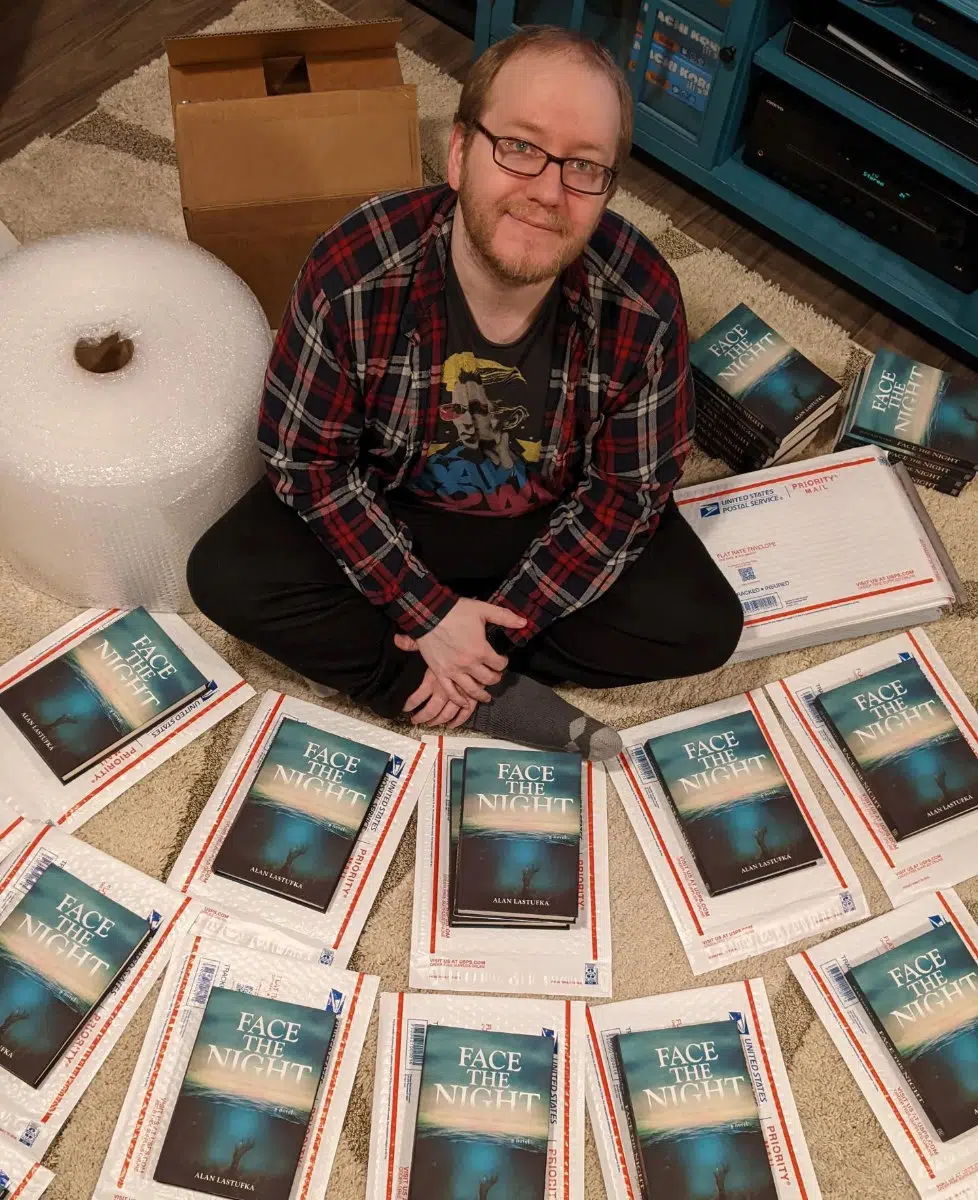
I have already written a NaNo 2.0 guest blog post that covered my first NaNo novel, Face the Night, and the success it found after publication: its unexpected awards and accolades and even a film option, leading eventually to a call with Netflix. So I won’t rehash any of that here except to say that my debut book—the draft of which was written over the course of a single November, 1,667 words at a time—opened doors and opportunities I’d only ever dreamed of.
During this process, I discovered how much I truly enjoyed putting together a quality book. I’d also found that my formal education in graphic design gave me the eye for detail needed in publishing, and my experience as a project manager meant I could make sure a ton of moving pieces eventually all fit together properly.
So when my friend Nicole Dieker started blogging about a cozy mystery series she’d begun writing but didn’t know what to do with, I reached out and asked if I could read it. Long story short, I loved the first book and her road map for future entries, so I bought the rights to her series for Shortwave, and now the press had a second author!
However, I knew that Shortwave couldn’t survive by releasing only books by me and my friends, especially in a saturated market like publishing (according to my last Edelweiss newsletter, there were 2,269 new book releases this week alone). We’d need to reach out to more established authors, carve out a niche, and make a little noise. That’s when I decided to introduce Shortwave to the horror writing community with an anthology project called OBSOLESCENCE, and in return get to read a ton of new-to-me horror authors all in one go.
I went all out. I planned a limited hardcover edition, a numbered edition, and a lettered edition… each with their own unique covers. I designed traycase-like boxes to hold each edition. And I planned a companion chapbook for the anthology to be included with the first print run.
I then asked my long-time friend Kristina Horner (20-time NaNo winner and the person who introduced me to NaNo) if she would co-edit the project with me. For half of the anthology, we invited some big-name indie horror authors (most of whom, surprisingly, accepted) and held open submissions for the other half. We had 12 slots to fill from open submissions, but we received over 600 short stories. All while only having published two previous books!
When I later asked the solicited big-name authors why they’d agreed to work with me when I had nearly no track record, most cited the cover designs and editions as a big draw. They could tell I was serious about the work and my press. That early support gave Shortwave a big leg up in the market and helped hundreds of other authors feel comfortable submitting to our first open call.
We eventually bought 27 stories for OBSOLESCENCE, and we’ve gone on to sign multiple book contracts for other projects now with half of those same authors. That anthology really was something special and is still our best-selling anthology to date.
From there, I had to figure out distribution and learned the difficult reality that good distributors wouldn’t consider a press—any press—until they had three years of sales data. So we self-distributed for those first three years. And even with that hurdle, we still had quite a few early wins…
One of our books received a glowing print review in the New York Times (“This book is a literary punch to the heart.”); some of our titles started to get picked up by universities and taught in classes; award nominations and wins started rolling in, including the Hugo, the Bram Stoker, the Shirley Jackson, the Nebula, and the Aurora, among others; The Wall Street Journal called one of our books “a nearly perfect, claustrophobic novella” in their Sunday print edition; we were reviewed in the print edition of Fangoria; and our titles landed on Esquire’s Best of the Year list…
And after three years of non-stop editing and marketing and publishing, Shortwave had sold nearly 50,000 books. Me, alone in a spare bedroom with no connections, no parent company, no investors, nothing but a NaNo book and a dream, had sold nearly 50,000 books.
It was time to reach out to distributors.
See, presses live and die by the quality of their distribution. Big chain retail bookstores won’t buy directly from small presses, and most of the time they won’t even buy from indie distributors like IngramSpark. I know because we used IngramSpark for the first three years of self-distro’ing, and I would routinely receive emails from Barnes & Noble booksellers who contacted me directly, apologizing that they couldn’t stock our books because (other than in rare scenarios) their ordering managers wouldn’t allow them to stock Print-On-Demand titles.
If we wanted our books to have a fighting chance on the shelves of bookstores around the world, we needed to land a real distribution deal. After a few false-starts and coming within days of signing a deal with a distributor just before they filed for bankruptcy, I was at my wit’s end. I’d taken meeting after meeting, I’d sent sample copies to multiple continents, I’d put together report after report, and we were having trouble finding a distro that understood what we were building…
“Oh, we already have a horror press, we don’t need a second one.”
It was maddening.
And then an editor from Simon & Schuster reached out to inquire about sublicensing the audio rights to one of our popular titles. That alone would have been a huge win, but I also knew Simon & Schuster offered distribution services to about 100 indie presses. After securing the audio rights deal, I mentioned how well that book was already selling, despite our current need for better distribution.
Thankfully, the editor understood the unasked question and offered to put me in touch with their VP of Distribution Services. I had literally been preparing for that meeting for months. No, years! The VP started the Zoom call and, after only 20 minutes, he offered me a contract. He said something along the lines of, “I can tell you’re ready. It usually takes me an hour or two to learn everything you’ve already shown me. Let’s do this.”
That was a few months ago. As I’m writing this, our first title just went live in Simon & Schuster’s catalog yesterday. I can’t wait to see where the next three years will take Shortwave, me, and our authors.
When I was introduced to NaNoWriMo founder Chris Baty, the first thing I did was thank him for the challenge that changed my life. From a self-published NaNo novel to a worldwide sales and distribution deal from one of the Big Five in just a few short years… Occasionally, reality can be just as cool as fiction.
Alan Lastufka is a Hoffer Award-winning author and the owner of Shortwave, an independent small press. He writes horror, supernatural, and sci-fi/fantasy stories.
His debut novel, Face the Night, received a starred Kirkus review, was a finalist for Best New Horror Novel at the Next Generation Indie Book Awards, and won the 2022 Hoffer Award for Best Commercial Fiction. It was also listed as one of the 100 Best Indie Books of the Year by Kirkus. When he’s not writing, Alan enjoys walking through Oregon’s beautiful woods with his partner, Kris.